
hls.js
Installation, supported players and devices, what the SDK does, how delivery is monitored, and the proof behind it, all in one place.
High-level comparison. Quanteec is designed to layer on top of your CDN, not to replace it.
Peer-assisted delivery is a software layer that runs inside your video player. Over WebRTC, the player exchanges already-cached media segments directly with nearby players running the same stream, while your CDN stays the source of truth and the fallback. The Quanteec SDK decides, segment by segment, whether to fetch from a peer or from the CDN, so delivery capacity grows along with the audience - no need for additional infrastructure.
Peer-assisted delivery is powerful, but it is not magic. Here is the straight version.
What you gain
What to plan for
We have a strong experience in device and player integration. We run a methodical onboarding to help you reach production fast, in a safe and efficient way.
Not real drawbacks: myths from old P2P
Today’s peer-assisted streaming is not the old P2P. Hover or tap a card to flip the myth and see the reality Quanteec proves.
Hard to integrate in the player
Teams expect weeks of custom work, forks and fragile changes to their video stack.
Drop-in SDK with clear docs
Quanteec plugs into the player with a few lines of configuration. No CDN or DNS changes. Compatible with HLS, DASH, DRM, analytics and existing ops, with detailed docs, a step-by-step process and guided support.
P2P is not safe and may breach security
Old peer-to-peer meant open ports and uncontrolled sharing, so teams assume encryption and DRM will break.
Security and DRM stay intact
Quanteec encrypts chunks, uses session-bound tokens over TLS and respects your DRM workflow. Peers never see decrypted media. It acts as a secured extension of your CDN edge, not an exposure point, and runs GDPR-compliant: peers exchange only encrypted media segments, never personal data.
P2P strains ISPs and creates bottlenecks
Extra uplink will clog last-mile links, and a bad peer will slow everyone else.
Network-aware and self-optimizing
Quanteec selects close, healthy peers, throttles rates and reroutes on loss. Local exchange eases backhaul, so hotspots dissolve instead of forming.
P2P is resource-heavy and intrusive
A heavy app that installs services, eats CPU, drains battery and seeds in the background.
Lightweight and policy-aware
Quanteec abides by operator policies: caps upload rate, minimises its footprint, prefers local or Wi-Fi, pauses on low battery or poor conditions and stops when playback ends. No background seeding.
Viewers pay for your upload
Teams worry about extra uplink costs and unhappy users.
Modern networks are built for two-way use
Video calls, gaming and social apps already use uplink. Quanteec keeps usage modest and configurable (Wi-Fi-only, rate limits, regional rules). In return, viewers get steadier quality, and platforms can add rewards through StreamBoost if desired.
P2P must add delay to re-stream between viewers
More hops must mean higher latency and poor live sync.
Ultra-low-latency, fully supported
Quanteec works with LL-HLS, LL-DASH, CMAF and WebRTS when needed. Peers fetch fast and re-stream almost instantly, keeping live within ULL targets, down to under 2s end-to-end in production.
A quick player-side integration, then a careful validation phase.
Open each step:
One of our three SDKs - Web, Android or iOS - inside the video player you already run. No new infrastructure to deploy.
Import the QUANTEEC plugin, add your key, and wrap your player instance. Your CDN and DRM stack stay exactly as they are, so there is nothing to deploy at the infrastructure level.
The integration itself is straightforward. Then comes the testing and validation phase, blending Quanteec into your delivery mix and tuning it per device, per network, per use case. It is the most complex and time-consuming part, so we run a methodical process to shorten and optimise it for you.
The Quanteec SDK sits inside your existing player and works with your CDN and DRM stack. No infrastructure changes, no lock-in, no blind routing decisions.
One peer-assisted layer, three SDKs: Web, Android and iOS. Below, the players and devices supported per SDK, with your CDN and DRM stack kept exactly as it is.
P2P plugin
Environments in production

Computers and mobile devices

Smart TVs
Players in production
hls.js
dash.js
video.js
Bradmax
Bitmovin
Shaka
OpenPlayer

RxPlayer
Clappr
Radiant
Castlabs
VisualOn
Dolby Theo
JW Player
Flowplayer

Brightcove
Environments in production
Smartphones, tablets, Set-top boxes and TVs

Set-top boxes and TVs
Players in production
Media3
ExoPlayer
Bradmax
Bitmovin
Castlabs
VisualOn
Dolby Theo
Environments in production


iPhone, iPad and Apple TV
Players in production
AVPlayer
Bradmax
Bitmovin
Castlabs
VisualOn
Dolby Theo
It installs inside your player, so there is nothing else to deploy. Three SDKs cover every surface, Web, Android and iOS, and the layer is light enough to run continuously and absorb traffic peaks, while your CDN stays in place as the safety net.
CPU stays close to flat: around +0% while receiving and up to +3% while sending (iOS +1.5% / +3.5%). Memory is programmable, the network footprint is configurable, and delivery uses at least 4x less energy than a CDN path.
Monitor CDN versus peer-assisted delivery, QoE, offload and segment routing at player level. Every decision is traceable by stream, event and viewer.
Identify and manage streams by site, location (city, region or country), IP, domain, popularity, network and device type, then apply operator policies such as device and upload caps, rules for metered networks or low battery, and geographic constraints, all without touching your encoding or CDN stack.
Automate configuration, feed these metrics into your own observability stack, and embed delivery tests into CI/CD.
 Peer-assisted delivery
Verified segments shared player to player.
 Player-level observability
QoE dashboard: CDN vs P2P and rebuffering per stream.
 CDN Selector
Player-level QoE picks the best CDN path.
 Security
Stream protection and CDN leeching controls.
 StreamBoost
Viewer participation rewarded through the engagement layer.
Same model as your CDN: you pay for the traffic delivered. The difference: the peak share that would have hit your CDN originally is now carried peer-to-peer by Quanteec at a much lower rate. You pay Quanteec out of the CDN savings, so your total delivery cost drops consequently.
Illustrative figures that assume high peer offload; actual savings depend on your offload rate and CDN pricing.
More than two years of peer-assisted delivery across demanding live events: sports, news and large-audience FAST. The proof is measured at player level, in offload, extra capacity and QoE metrics.
CDN offload
82%
at peak, 18% on the CDN
Extra capacity factor
×6.34Max
peers on top of the CDN, carrying the peak
Rebuffering rate
0.27%
P2P, vs 0.51% on CDN only
Delivery energy
−46%
vs CDN only, same or better QoE
Example figures from our most recent highlight event. Results vary by event, audience and content.
Click any event to see how Quanteec delivered it: the technology used and the numbers behind it.
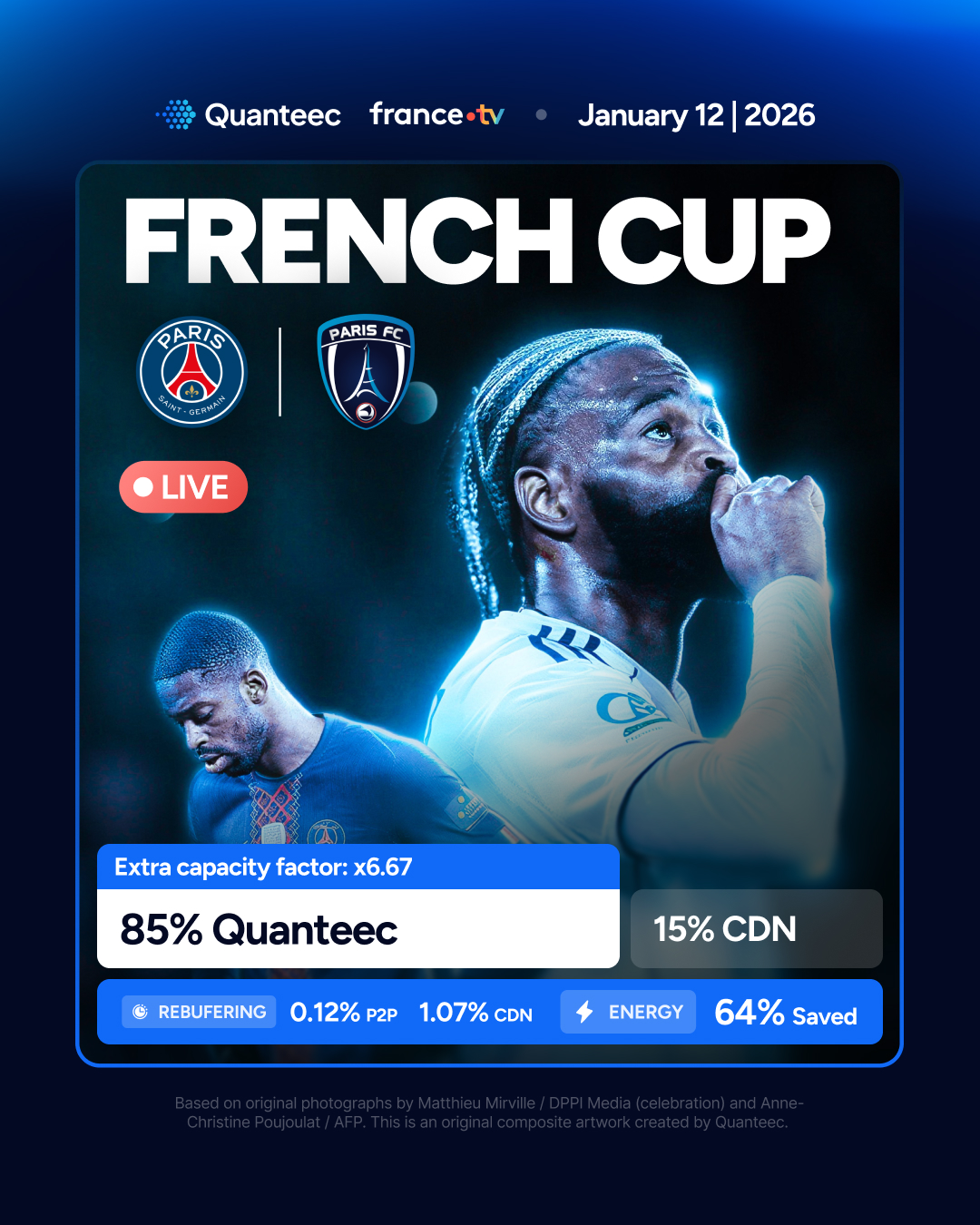
On Monday 12 January 2026, the Coupe de France round of 32 sent Paris Saint-Germain against their city neighbours Paris FC at the Parc des Princes, a Parisian derby that drew a large national live audience. Paris FC pulled off a historic upset, winning 1-0 with a late Jonathan Ikone goal to knock the holders out of the cup.
As the derby went to the wire and the shock result kept everyone watching, viewers across France piled onto the stream at once. Quanteec carried 85% of delivery peer-to-peer, an extra capacity factor of x6.67 on top of the CDN, while the CDN stayed the safety net for the remaining 15%. Rebuffering held at 0.12% versus 1.07% on the CDN path, and the session saved 64% of delivery energy, with the peak absorbed without provisioning more CDN.
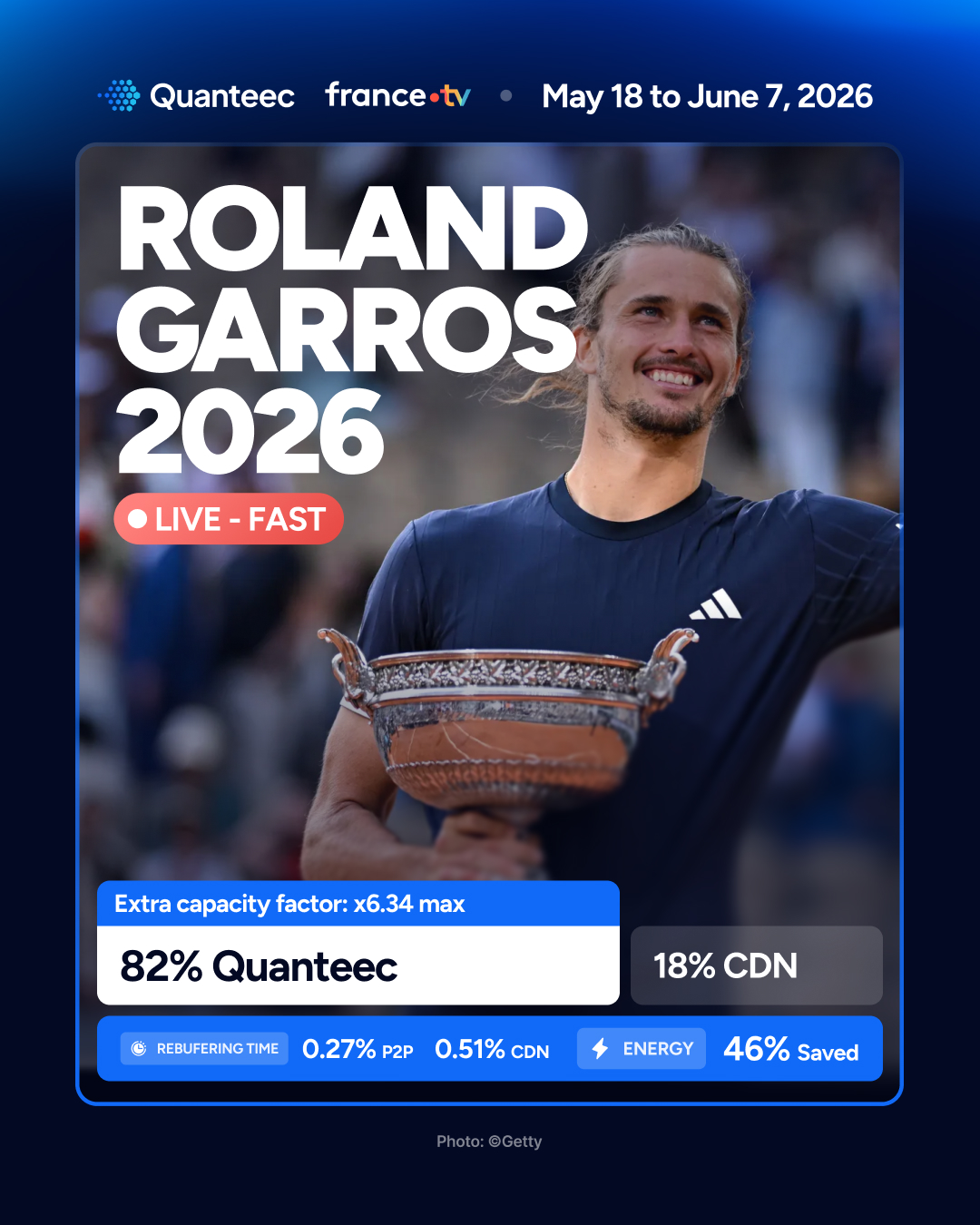
The clay-court Grand Slam ran from 18 May to 7 June 2026 in Paris. Play was spread across several courts at once: day sessions from late morning and a marquee night session on Court Philippe-Chatrier in the evening, right in European prime time.
French audiences followed it region by region, and the sharpest peaks formed when popular afternoon matches overlapped or when a night session opened, with large numbers of viewers pressing play within the same few minutes. As concurrency climbed, viewers on the same regional networks shared verified segments peer-to-peer, so the peer-assisted layer carried a growing share of delivery and demand on the CDN stayed flat right through each peak.
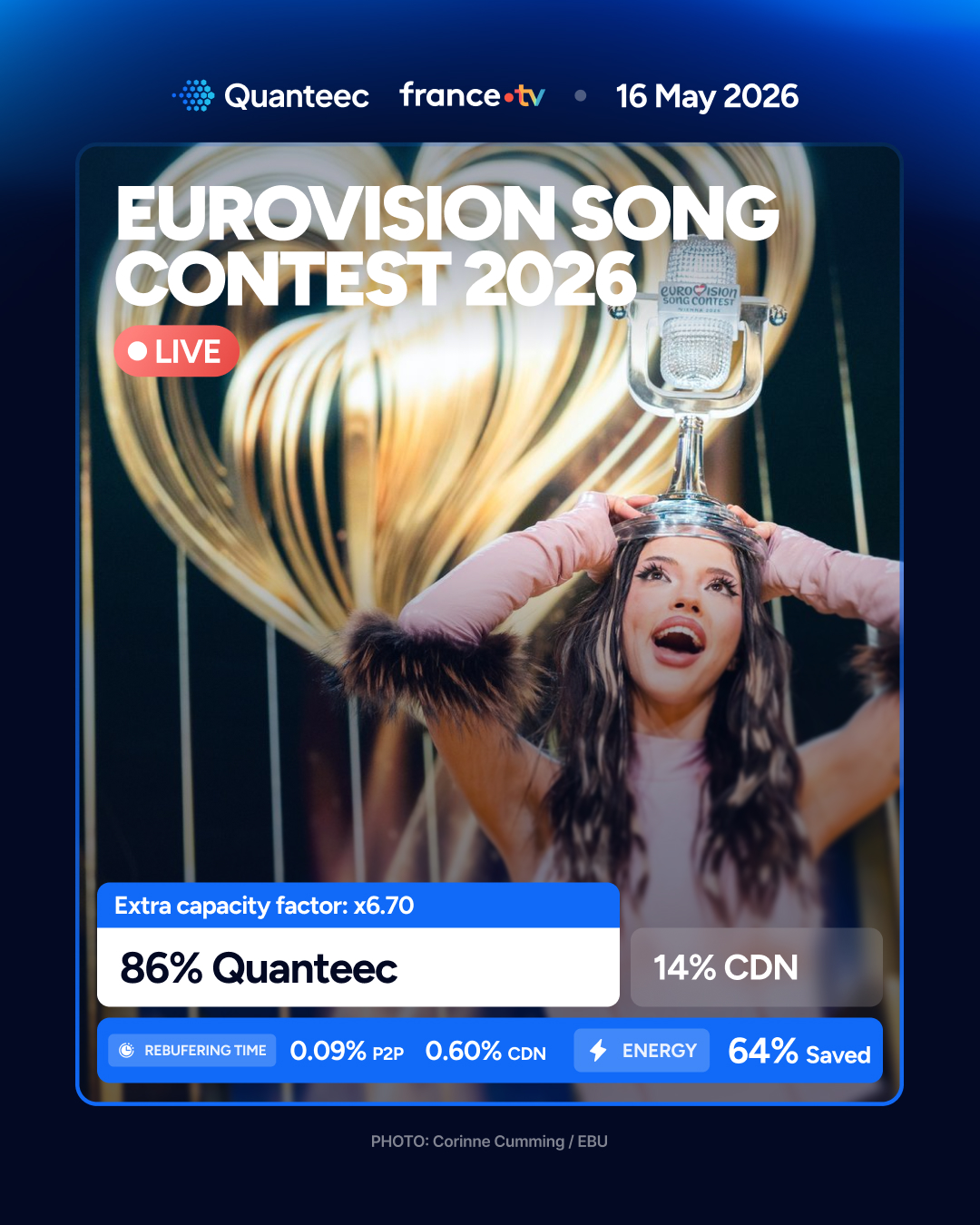
The Eurovision Song Contest 2026 was held in Vienna, with two semi-finals on 12 and 14 May and the grand final on Saturday 16 May. The final aired live across Europe in Saturday prime time, around 21:00 CET, so the whole continent watched the same stream at the same moment.
In France the audience climbed across every region at once, and the peak grew sharper around the French entry and the voting. Because so many viewers sat on identical segments at the same second, peers had plenty to share locally, so peer-assisted delivery took the lead over the CDN at the height of the show and absorbed the surge while quality held steady.
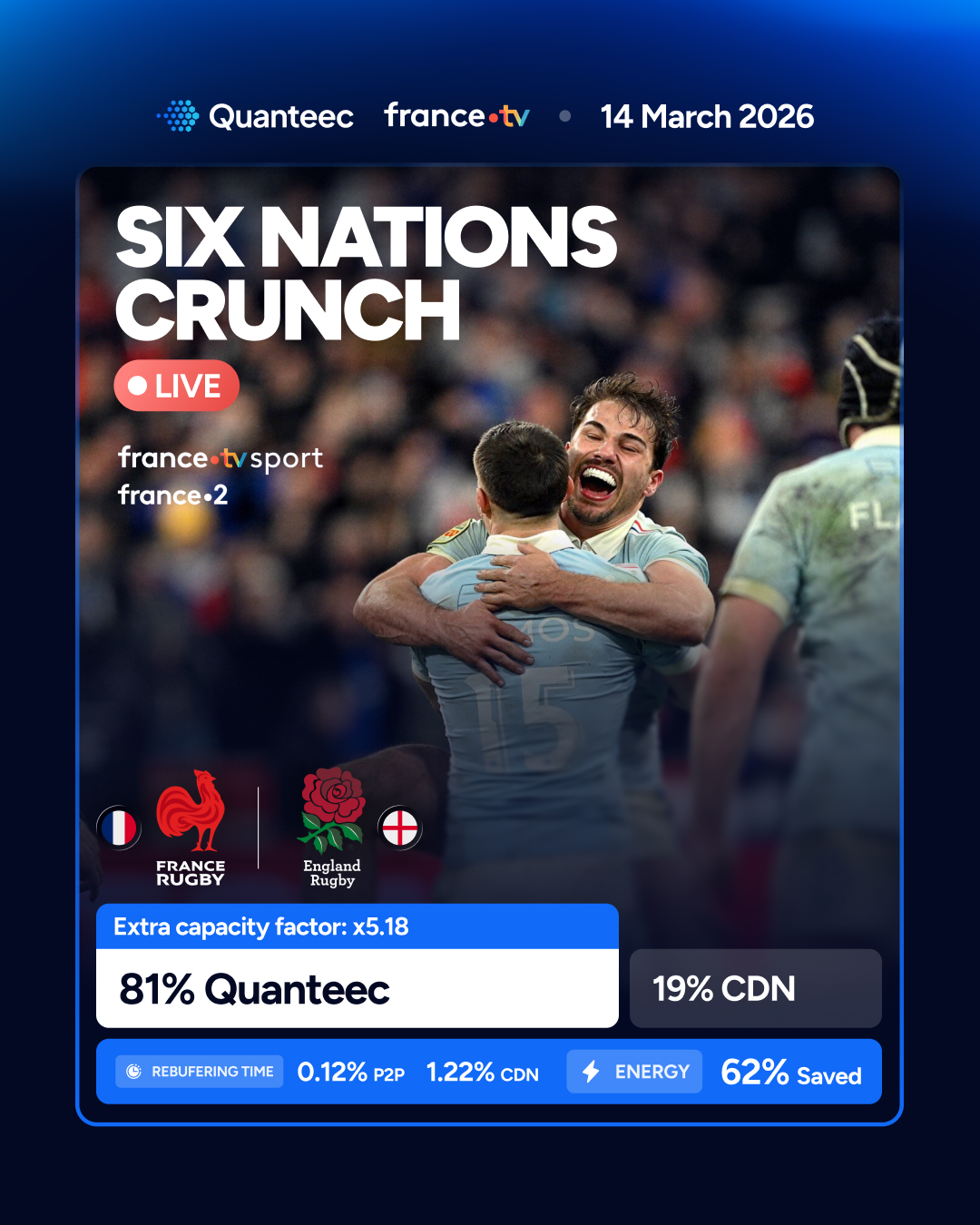
France Télévisions · France 2 + france.tv sport
France vs England, the most anticipated match of the Six Nations tournament, aired simultaneously on France 2 and france.tv sport, drawing the largest audience of the 2026 edition.
Quanteec handled the peak with 81% offload through peer-assisted delivery, keeping rebuffering at 0.12% versus 1.22% on the CDN path and saving 62% of energy over the session. With an extra capacity factor of ×5.18, the match was delivered without additional infrastructure, exactly when it mattered most.
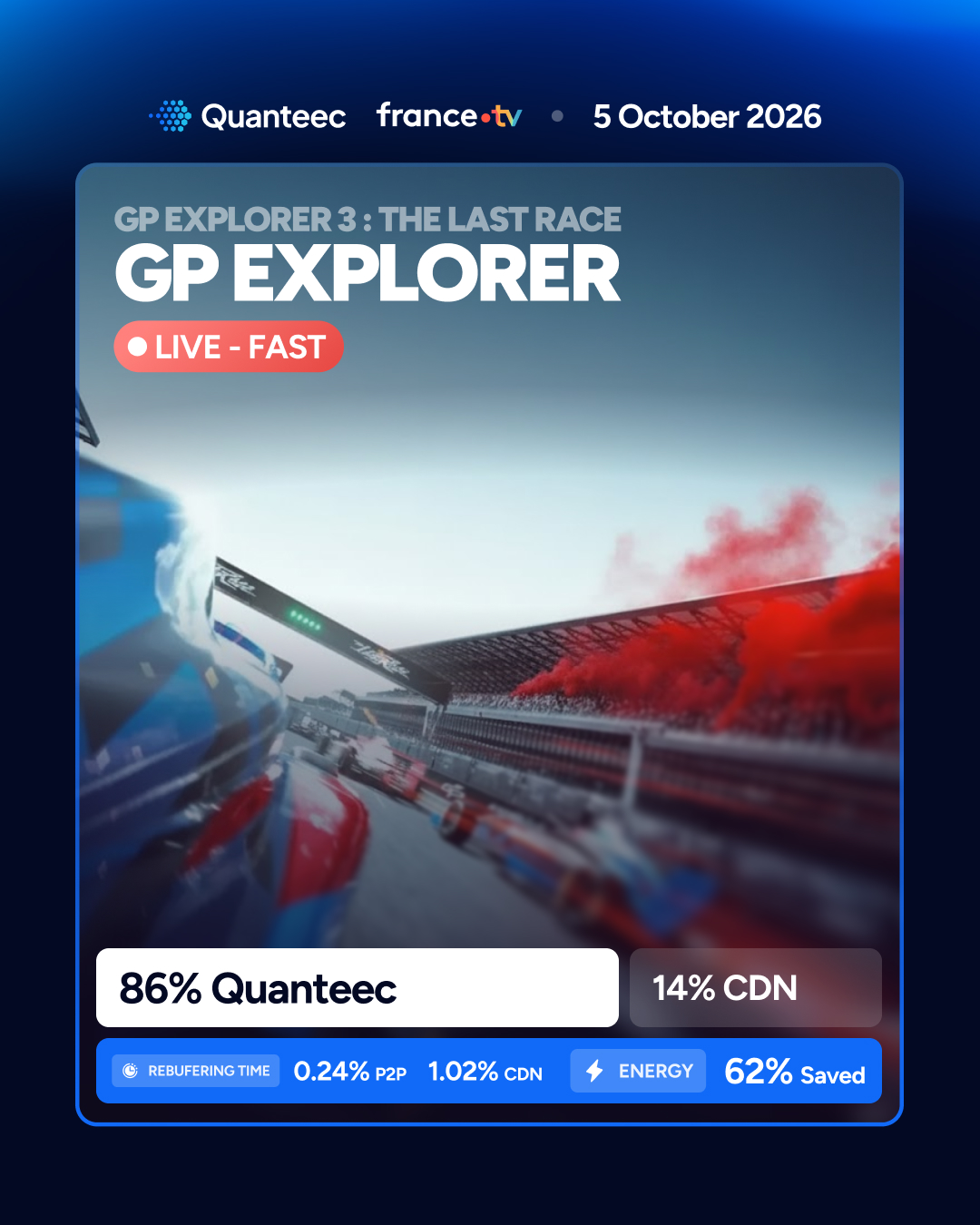
France Télévisions · France 2 + france.tv
On 5 October 2025, France Télévisions brought the creator-led GP Explorer 3 to broadcast and france.tv. Built by streamers for a young, social-first audience, it set a new French record on Twitch, while france.tv viewers followed qualifying, the main race on France 2, and a multi-stream setup with 24 onboard camera feeds.
Across all france.tv streams, Quanteec’s peer-assisted delivery held smooth playback during audience surges, keeping a record-setting, creator-driven event at broadcast-grade quality across simultaneous feeds.
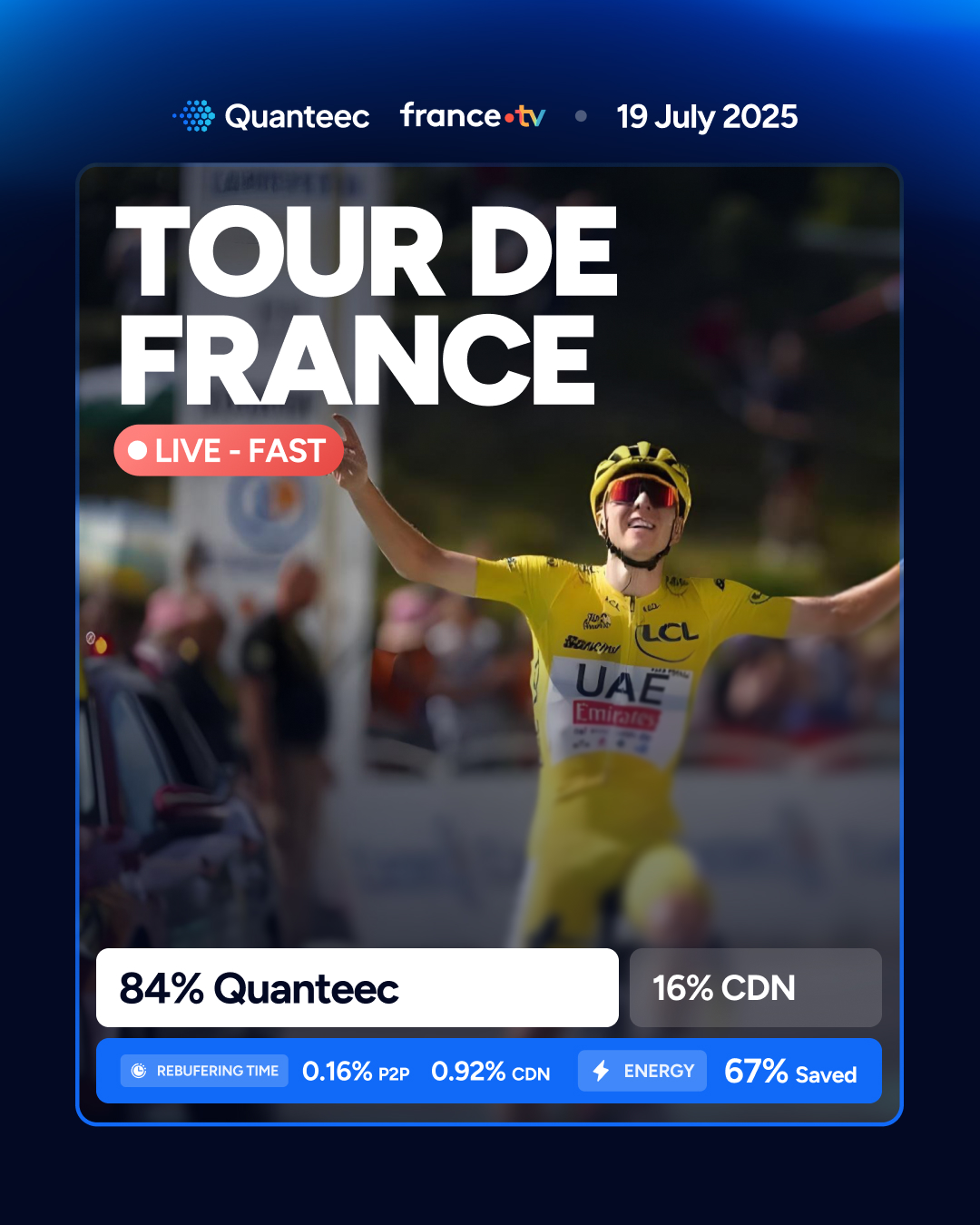
France Télévisions · france.tv
Quanteec supported the live streaming of the Tour de France, one of the world’s most important sporting events. With hundreds of thousands of viewers connected across devices, peer-assisted delivery ensured stable quality at scale while easing CDN load.
France Télévisions teams accessed real-time edge analytics and explored every configuration in detail, enabling adjustments that improved the experience for the whole audience. This 2025 edition became the most-watched in the history of france.tv.
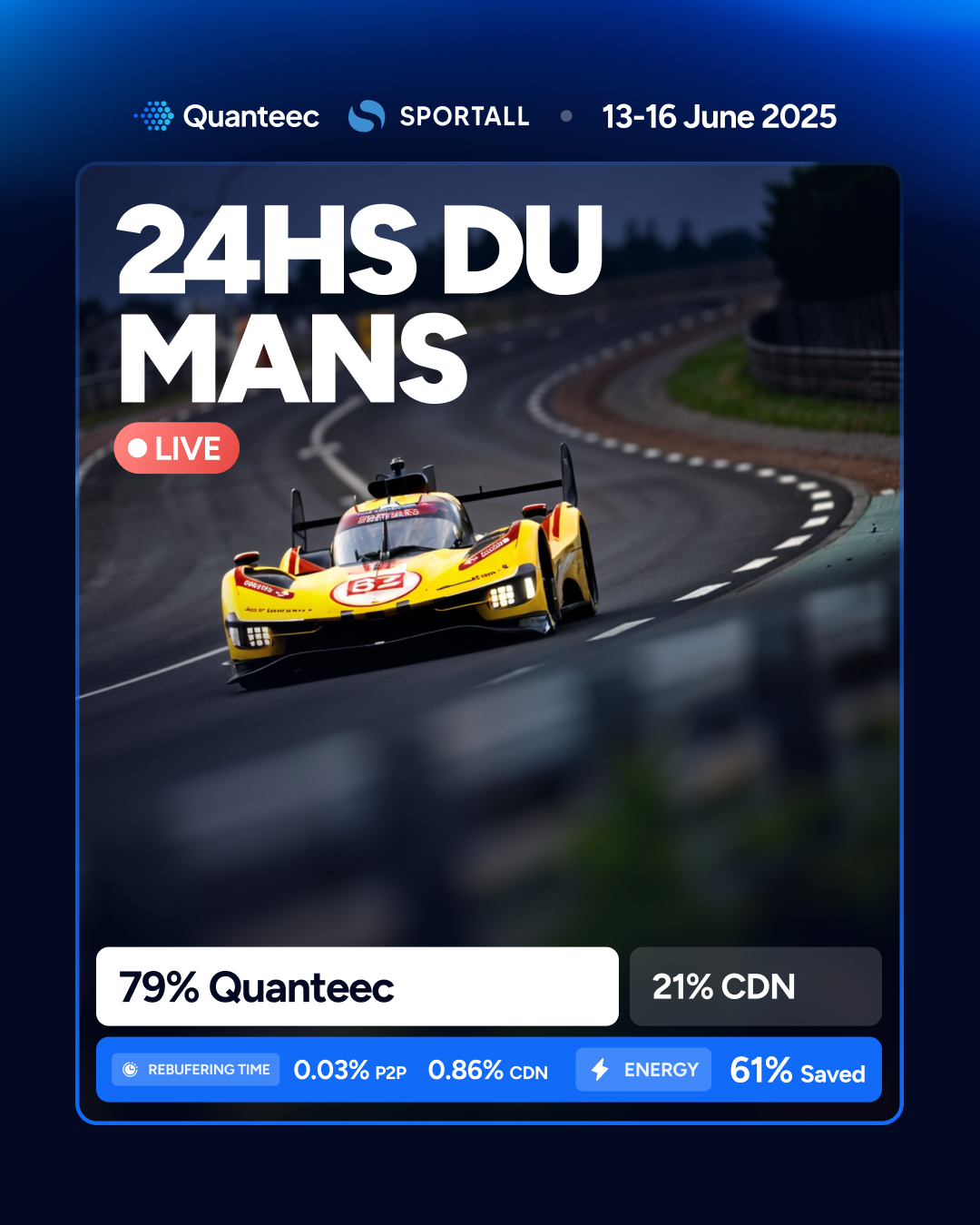
Sportall · Bitmovin player
In June 2025, the 24 Hours of Le Mans, the fourth round of the FIA World Endurance Championship, ran at the Circuit de la Sarthe. A channel from the Sportall network brought the event to its community during the race weekend.
Across the live coverage, several audience peaks occurred and Quanteec’s peer-assisted delivery absorbed them without compromising the experience, while staying CDN- and player-agnostic and adding elastic capacity on the fly.
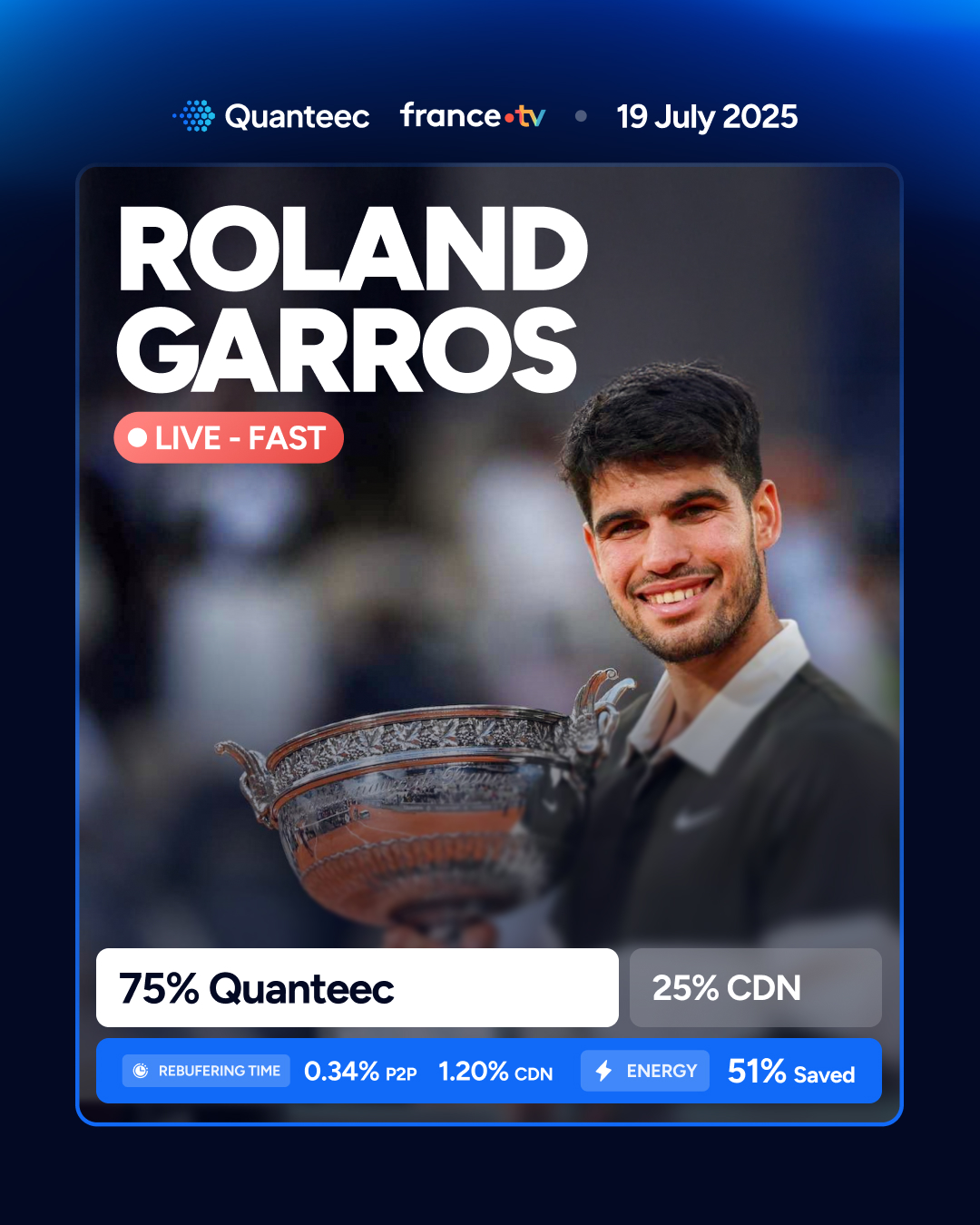
France Télévisions · france.tv (FAST channels)
For the 2025 special edition, alongside its linear channels, France Télévisions launched dedicated FAST channels to bring Roland-Garros closer to fans everywhere. Hundreds of thousands of viewers connected simultaneously across devices on Quanteec’s peer-assisted delivery.
The final match became the most-watched event in the history of france.tv (excluding the Olympics), making the delivery results especially representative of performance under pressure.
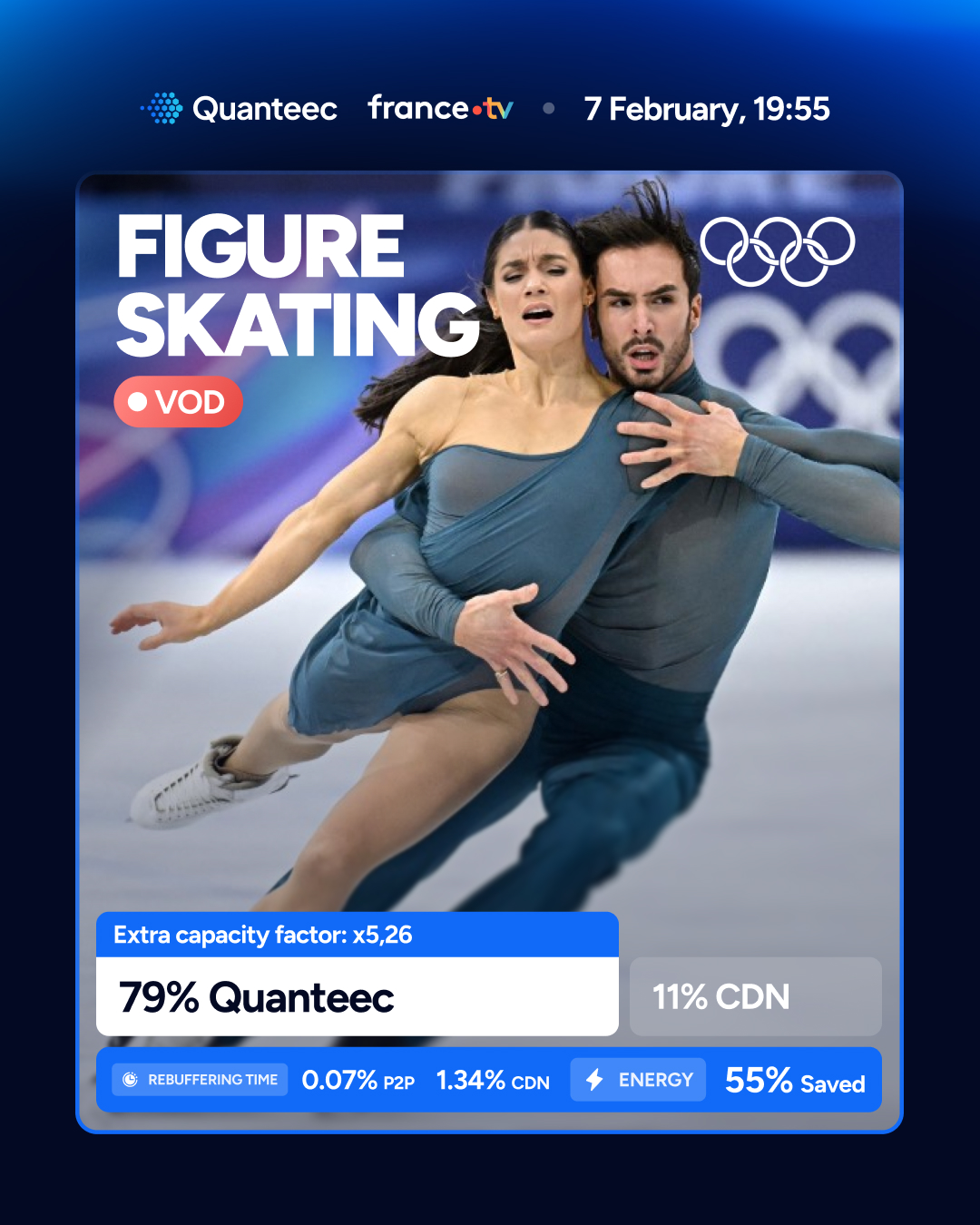
France Télévisions
Figure skating combines appointment-viewing peaks with a loyal, highly engaged audience following marquee programmes live.
Quanteec’s peer-assisted delivery supported the live streams, adding capacity during concurrent peaks while keeping the experience smooth across devices. Full delivery metrics are available on request.
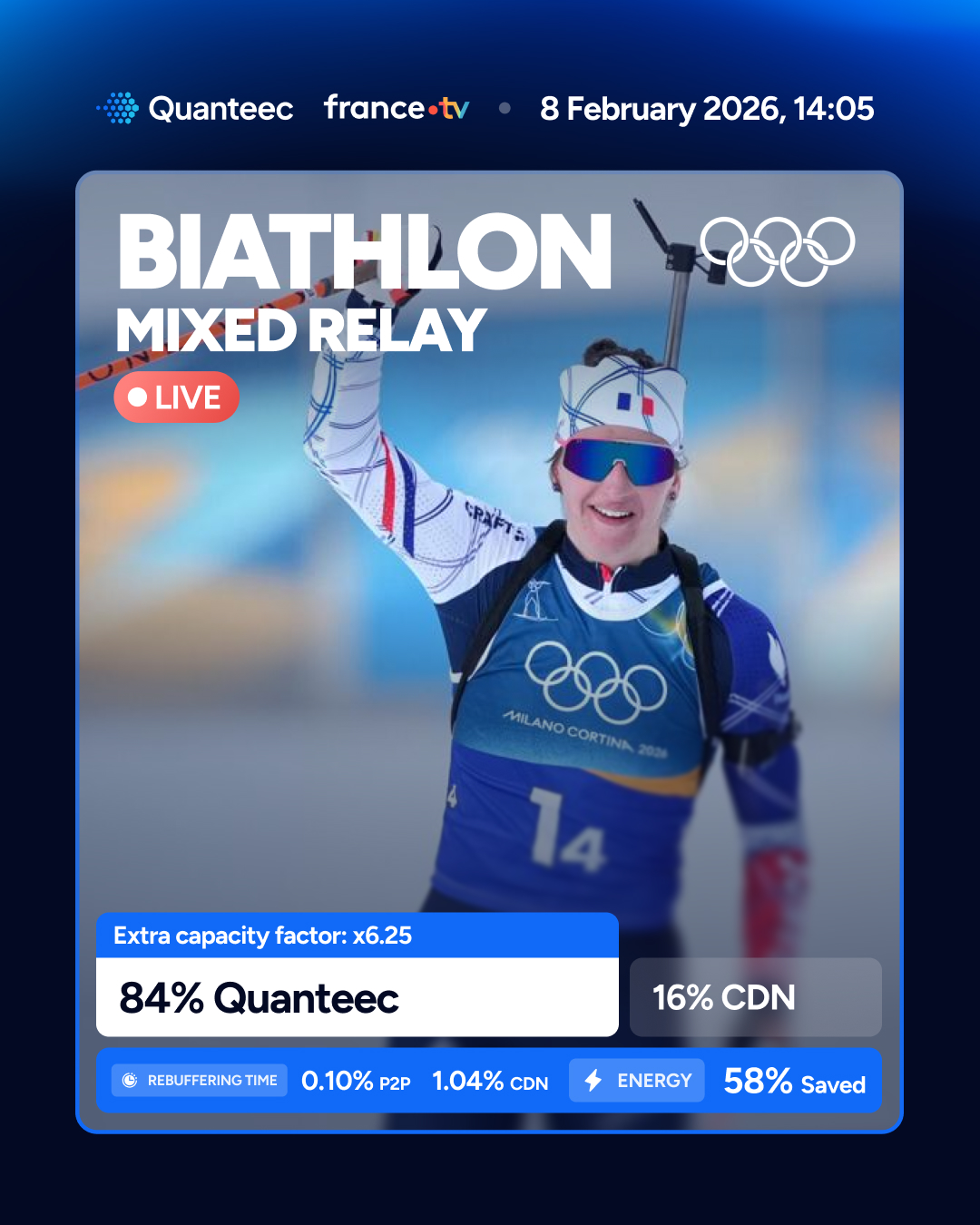
France Télévisions
The biathlon mixed relay is one of the winter season’s most-followed formats, with fast, simultaneous viewing peaks as the race builds.
Quanteec’s peer-assisted delivery absorbed those surges on top of the CDN, keeping live quality steady for the audience. Full delivery metrics are available on request.
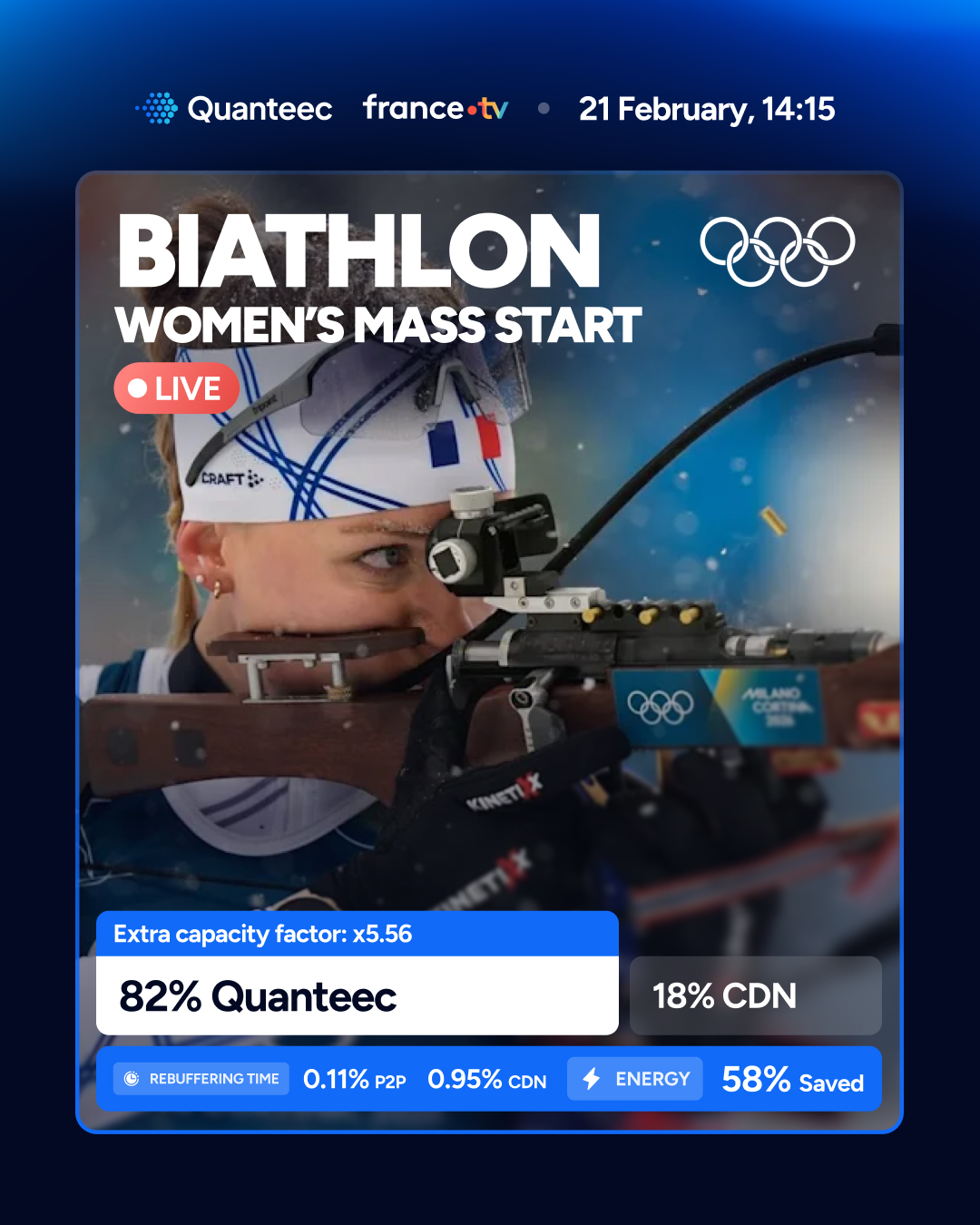
France Télévisions
Women’s biathlon races draw a dedicated live audience across the winter season, with sharp concurrent peaks around key events.
Quanteec’s peer-assisted layer added elastic capacity to absorb the peaks while holding playback quality. Full delivery metrics are available on request.
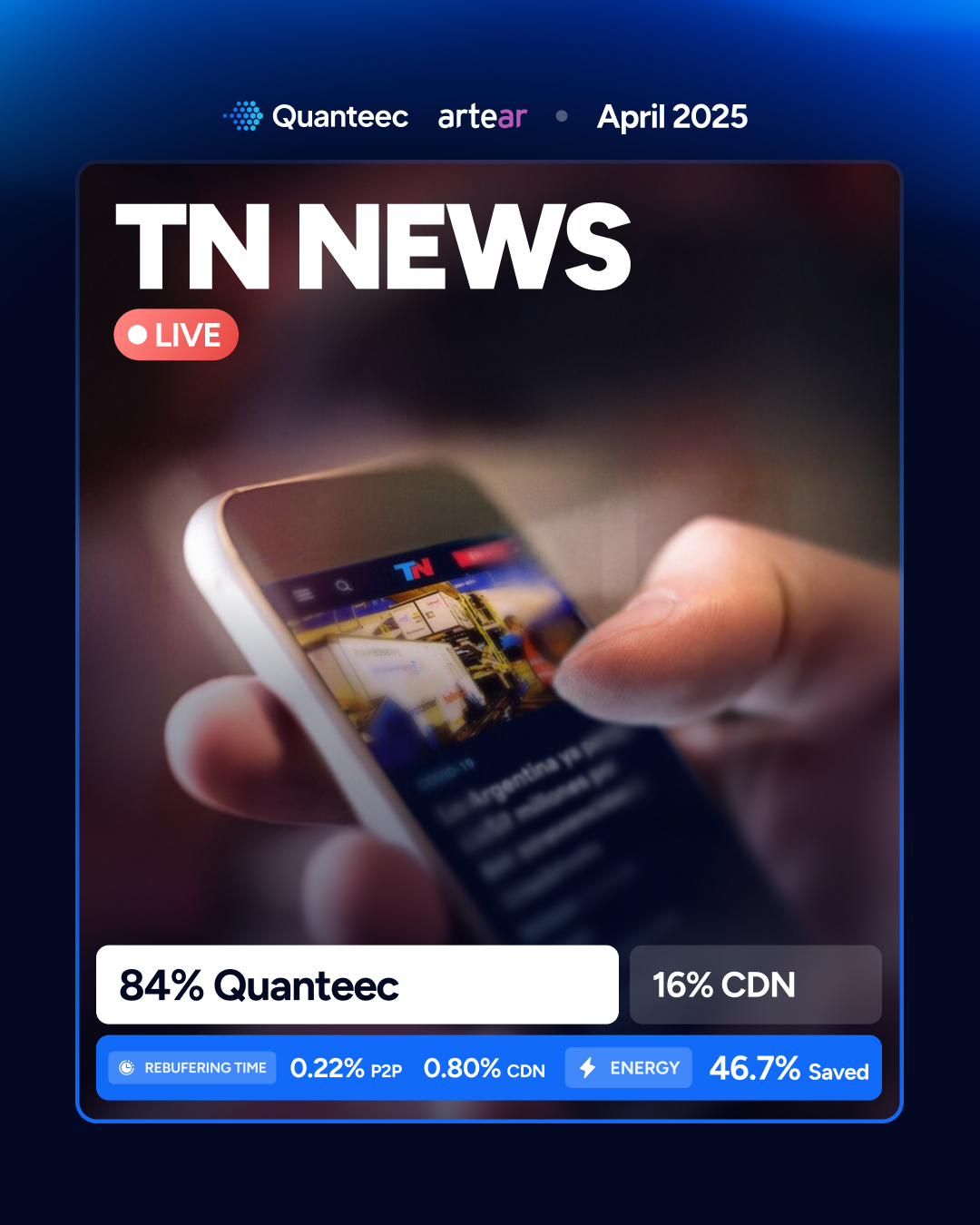
TN, Todo Noticias (Argentina)
In April 2024, Argentina’s leading news channel TN ran a performance analysis with Quanteec’s peer-assisted delivery. Unlike live sports with sharp peaks, a 24/7 news channel has a constant, stable flow of viewers, an ideal case to measure Quanteec under regular conditions while staying ready for unexpected surges.
The study showed consistent quality and reliability for continuous streaming, with measurable cost savings, and the confidence of being prepared for any unexpected spike.
Quanteec is the peer-assisted delivery provider for


Peer-assisted delivery can reduce energy drawn across the delivery chain. Track delivery efficiency in the dashboard alongside offload and data volume.
Still have a question we didn’t answer?
Contact us to try Quanteec on your content.
We will show you how peak offload changes CDN cost, quality and delivery risk.
We respond within one business day.
Thanks. We will reach out to set up your session.